By Dr. Jackson Bartlett, Executive Director
My team and I have had a lot of opportunities to get out and get moving on the Appomattox River Trail this summer. It’s certainly hot, but summer is a slow time for us, and with the right precautions it can be a beautiful time along the river.
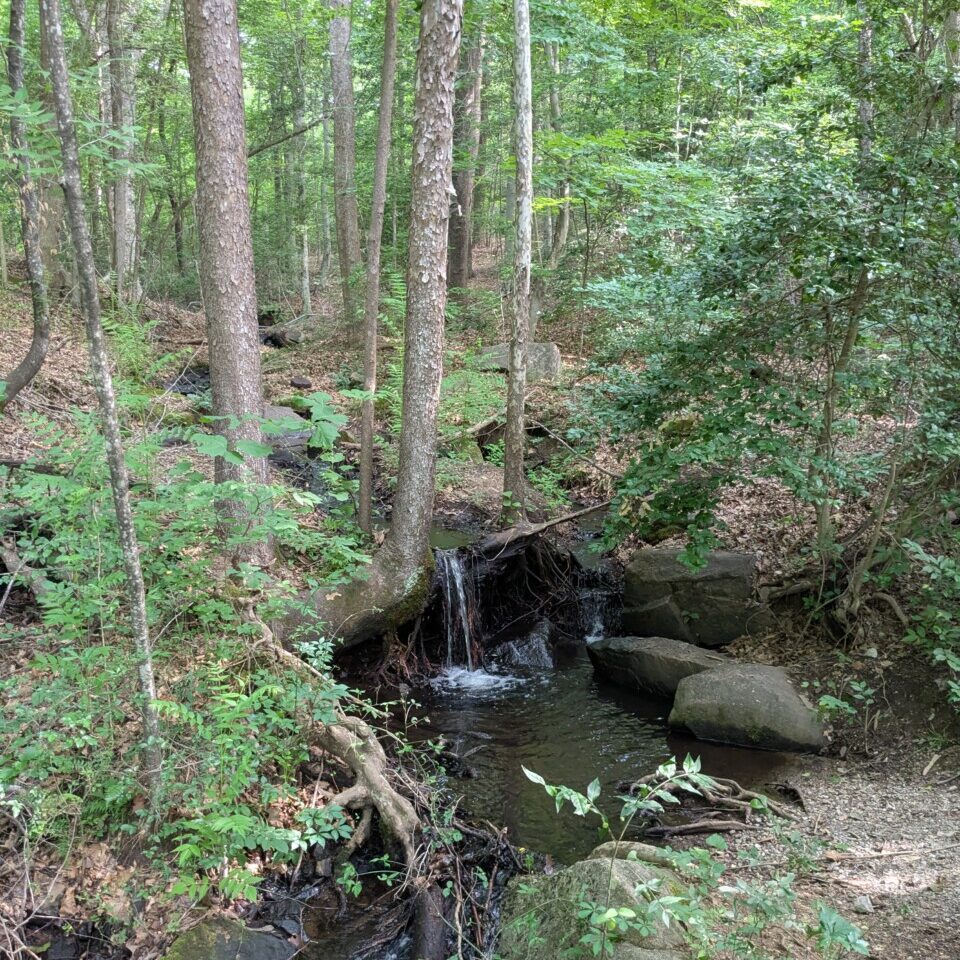
One of those opportunities to get out and get moving was June’s “Restore and Explore” walk through the John J. Radcliffe Conservation Area, at the western end of the ART. We go on these walks every month and there’s one rule: no work talk. It’s a hard rule to follow, but our intent is to observe local ecology, connect with nature, and enjoy the beauty and splendor of the Appomattox River. That’s the “explore” part of it. The “restore” part is all about the health benefits of spending time in nature.
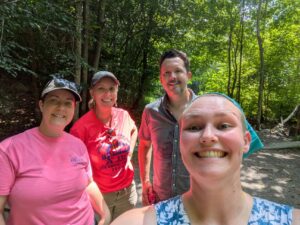
The FOLAR team at John J Radcliffe Conservation Area. From left: Elise Neuscheler, Heather Barrar, Jackson Bartlett, Emily Galbraith
Research shows that there are many benefits to getting out in nature. Humans are nature, of course. We’ve evolved to have an affinity for our natural surroundings. Bird calls, for example, indicate environmental safety and access to water. It’s just that many aspects of modern life divorce us from those surroundings, creating mental fatigue and buildup of chronic stress we were never meant to experience. Sitting at a desk, digital immersion, and constant stimulation all go against our nature.
Spending time outdoors can relieve this stress. More specifically, it puts a biological brake on the fight-or-flight stress response, with the sights, sounds, and smells of the outdoors activating the parasympathetic nervous system to reduce blood pressure, heart rate, and cortisol levels, and bring the body back to homeostasis. Time in nature also helps us overcome mental fatigue by redirecting our attention and helping us be more present. Have you ever stopped to listen to the wind blow through the leaves while birds sing and a river rushes in the distance? Think about how that feels. In a very real sense, it’s our bodies coming home.
While the research shows us that being in nature helps relieve the stresses of modern life, it also shows those stressors increasing. There’s been a rapid acceleration of work and productivity. It’s as if our ability to work through a global emergency meant that there would be no holds barred moving forward. For many people, this acceleration has been forced. For those of us lucky enough to do work we’re passionate about, we’ve sometimes done this to ourselves, exploiting ourselves in the name of a strong mission statement or sense of duty. “If I don’t do it, who will?” We’ve all had this exchange–
“Hey, friend, how are you?”
“Oh, I’m hangin’ in there, how about you..”
Underneath the side-eyes and sighs are overtaxed bodies and weary hearts. Health issues we’re “too young” to be having. Disability. Family members who need care. Political crises we’re not talking about. Instability in our communities. We’re exhausted and burned out to the point where even days off can feel restless.
We know there are a lot of things that need to happen for us to fix this. We need better access to healthcare and healthy foods. We need better transit, more physical activity, and walkable cities. But the research is clear: we also need to reconnect with nature.
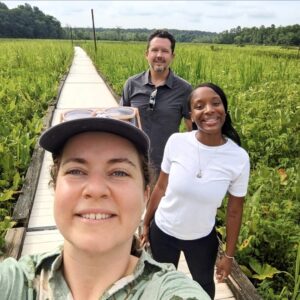
Showing our intern R. Garland Dodd Park at Point of Rocks. Front to Back: Elise Neuscheler, Arabia Earth, Jackson Bartlett
So, at Radcliffe, we stopped to see incredible views along the Appomattox. We listened to the birds, and took in the smells of the forest. We saw a skink skitter across a rock, and a blue heron fly away with a fish in its mouth. I felt my nervous system settle. We climbed out onto the rocks to watch hundreds of dragonflies feast on mosquitos (thanks, dragonflies). Elise told us about how dragonflies have a direct nerve connection between the eyes and the wings, bypassing the brain to track prey in the air.
Yesterday, I walked from my house to another site along the Appomattox: the overlook at University Boulevard. Standing just above the rapids, I inhaled the elevated levels of oxygen, ozone, aquatic bacteria, and negative ion saturation that make the smell of churning water so seductive to the human brain. It’s an ancient switch drawing us to fresh, life-sustaining water. There’s something about being in a timeless ecosystem and realizing that you’re a part of it that’s healing. I want everyone to have access to that experience.
The Appomattox River Trail isn’t just a bike trail. It’s an opening up of the river and natural world to everyone in our community. Its pathways and parks turn the river from our back yard into our front yard. There are no gates. You don’t need to purchase a ticket. It’s a path home that’s free and accessible to everyone.